
The best Weather Activities Preschool are short, hands on projects that let 3 to 5 year olds see, touch, and move with the weather, like straw blown rain clouds, a shaving cream rain cloud jar, clothing sorts, play dough weather mats, and a daily weather wall. Keep each one to 10 to 20 minutes, alternate messy and tidy setups, and start every activity by looking out the window at the real sky.
You set out a bag of cotton balls for a cloud craft. Ten minutes later, exactly one cotton ball is glued to the paper. The rest are in the air, in someone’s hair, and under the rug, because your preschooler has decided clouds are actually snowballs.
Then the rainy day activity you planned gets called “boring” before the paint is even open.
Weather should be the easiest topic in the world for little kids. It happens to them every single day. But sunny, rainy, windy, and snowy are slippery ideas when you’re three, attention spans are short, and every messy setup is extra work for you.
The fix is making weather feel like play, not school. When kids blow paint into rain, spray water at paper clouds, or roll play dough into sunbeams, they learn what each kind of weather looks and feels like, and they stay busy while they do it.
Below are 20 weather activities for preschoolers that work at home or in a classroom. Each one comes with ages, honest time estimates, a mess rating, and what usually goes wrong on the first try. Most use supplies already in your craft drawer, and anything you’d need to buy comes with a free swap.
If you’re planning a fall 2026 unit, the rain and wind projects are a natural place to start while the season is changing outside your window.
How Can Preschoolers Learn About Sunny, Rainy, Windy, and Snowy Days?
Preschoolers learn weather by feeling it, not by hearing about it. A three year old can’t hold on to the word “windy” until they’ve watched a ribbon whip sideways or chased a pinwheel across the yard.
So the trick is matching each type of weather to something kids can do with their hands and bodies:
- Windy: wave ribbons or scarves outside, blow pinwheels, or blow paint across paper with a straw.
- Rainy: spray bottles, droppers, water trays, and paint that drips down a page.
- Sunny: trace shadows at different times of day, make sun crafts, and talk about why we wear hats.
- Snowy: white paint stamps, cotton ball snow, and melting ice cubes in a tray (even if you live somewhere it never snows).
Then add one tiny daily habit, like checking the window each morning and moving an arrow on a weather wall. The crafts make weather exciting. The routine makes it stick.
Hands on activities about weather for preschool also do something worksheets can’t: they let kids get it wrong safely. When a child sorts a wool hat into the sunny pile, you get a real conversation instead of a red X.
Practical note: Look outside before every weather activity. Ten seconds at the window (“What do you see? Is the tree moving?”) turns a craft into a science lesson.
Preschool Weather Activities at a Glance
Use this table to choose activities about weather for preschool by time and mess. “Mess” assumes you’ve covered the table, and “Skill” is how much fine motor control or patience the activity asks for.
| # | Activity | Weather | Best ages | Time | Mess | Skill |
| 1 | Weather Wall | All types | 3 to 5 | 30 min to make, 2 min daily | Low | Easy |
| 2 | Cloud Study | Clouds, rain | 3 to 5 | 15 to 20 min | Medium | Easy |
| 3 | Rain Spray | Rain | 3 to 5 | 20 min plus setup | High | Easy |
| 4 | Outfit Match | Hot, cold | 3 to 4 | 10 min | Low | Easy |
| 5 | Rainbow Art | Rainbow | 3 to 5 | 30 min | High | Easy |
| 6 | Snow Stamps | Snow | 3 to 5 | 15 min | Medium | Easy |
| 7 | Weather Spinner | All types | 3 to 5 | 5 min daily | Low | Easy |
| 8 | Drip Paint | Rain | 4 to 5 | 20 min | High | Medium |
| 9 | Weather Table | All types | 3 to 5 | 20 to 30 min | Medium | Medium |
| 10 | Umbrella Art | Rain | 4 to 5 | 25 min | High | Medium |
| 11 | Rain Clouds | Rain, wind | 4 to 5 | 15 min | Medium | Medium |
| 12 | Weather Clothes | Snow, cold | 4 to 5 | 15 min | Low | Medium |
| 13 | Cloud Craft | Clouds | 3 to 5 | 20 min | Medium | Easy |
| 14 | Water Play | Rain | 3 to 5 | 20 to 40 min | High | Easy |
| 15 | Weather Sort | Sun, snow, rain | 4 to 5 | 15 min | Low | Medium |
| 16 | Rain Painting | Rain | 3 to 5 | 20 min plus drying | Medium | Easy |
| 17 | Winter Scene | Snow, seasons | 4 to 5 | 30 to 45 min over 2 days | Medium | Medium |
| 18 | Rain Station | Rain | 4 to 5 | 45 min to build | Low | Medium |
| 19 | Weather Wheel | All types | 3 to 5 | 45 min to make, 2 min daily | Low | Easy |
| 20 | Rain Boots | Rain | 3 to 5 | 25 min | Medium | Easy |
Ages, Time, and How Much Help Kids Need
Most weather activities preschool groups do can stretch across the whole 3 to 5 range. You adjust the job, not the activity.
Young 3 year olds (and toddler siblings tagging along)
- Give one job per activity: stamp, spray, press, or post a card.
- Plan for 5 to 10 minutes of focus, and stop while it’s still fun.
- Expect every paint color to end up mixed into brown. For this age, that is the activity.
- Skip anything with small loose pieces.
4 year olds
- Can follow two or three step directions and use droppers, glue bottles, and clothespins with a little help.
- Plan for 10 to 20 minutes.
- Start asking “why” questions: Why did the cloud get heavy? Why do we wear boots in the rain?
5 year olds and older preschoolers
- Can sort into three or more groups, write labels with invented spelling, and help set up.
- Plan for 20 to 30 minutes, or split bigger projects across two days.
- Add counting, letters, or sight words to crafts (the Rain Station is perfect for this).
Supervision at a glance: Anything with water, droppers, straws, small pieces like pom poms, or scissors needs an adult within arm’s reach. Sorting games, spinners, and wall routines can run with you nearby but not hovering.
Supplies for Preschool Weather Activities (Plus Free Swaps)
You don’t need a special kit for weather activities for preschool. Almost everything here is a craft drawer staple, and every bought item has a free or low cost swap. I pick up paint and glue at Target, Walmart, or Amazon, and liquid watercolor and pipettes from a school supplier like Discount School Supply.
| Item | Used in | Where to get it | Free or low cost swap |
| Washable paint (Crayola Washable Kids’ Paint or similar) | Rainbow Art, Rain Spray, Snow Stamps, Rain Painting, Rain Boots | Target, Walmart, Amazon | Cornstarch, water, and a few drops of food coloring stirred into a thin paste |
| Liquid watercolor (Colorations) | Drip Paint, Cloud Study, Rain Clouds | Discount School Supply, Amazon | Food coloring in water (stains hands more), or tempera thinned with water |
| Droppers or pipettes | Cloud Study, Drip Paint | School suppliers, pharmacies | Old medicine droppers, a teaspoon, or a squeeze bottle |
| Foam shaving cream (Barbasol Original) | Cloud Study | Drugstores, supermarkets | A kitchen sponge as the “cloud” |
| Cotton balls | Cloud Craft, Winter Scene, Weather Wheel | Drugstores, dollar stores | Torn white tissue paper, or stuffing from an old cushion |
| Small spray bottles (2 to 4 oz) | Rain Spray | Dollar stores, travel aisles | Flick water off a wet paintbrush |
| Clear dome umbrella | Umbrella Art, Rain Station | Walmart, Amazon | An old clear shower curtain liner draped over two chairs |
| Plastic clothespins | Weather Clothes | Dollar stores | Wooden laundry pegs, or chip clips |
| Play dough | Weather Table | Supermarket toy aisles | Homemade dough (recipe in the Weather Table section) |
| Dot markers (Do A Dot Art) or round stickers | Rain Boots | Amazon, craft stores | Cotton swabs dipped in paint |
| Felt sheets | Weather Wall | Craft stores, dollar stores | Cereal box card colored with markers |
| Paper plates | Rain Painting, Snow Stamps, Weather Spinner | Supermarkets | Leftover party plates, or card circles cut from a box |
| Pipe cleaners | Weather Wheel, Rain Painting | Craft aisles | Strips of black paper, or yarn |
| Brass paper fasteners | Weather Spinner, Weather Wall | Office supply stores | A clothespin arrow clipped to the edge |
| Water tray or large bin | Water Play | School suppliers, hardware stores | Under bed storage box, baby bath, or the bathtub |
| Paper roll (IKEA MÅLA) | Rainbow Art, Drip Paint | IKEA, Amazon | Flattened cardboard boxes, or the blank side of old wrapping paper |
| White liquid glue (Elmer’s School Glue) | Cloud Craft, Winter Scene | Anywhere school supplies are sold | Flour and water paste |
Mess and Safety Notes Before You Start
Most weather activities for preschool involve water or paint, and wet means slippery floors and stained sleeves. Ten minutes of setup saves you forty minutes of scrubbing.
Mess control that actually works
- Cover the floor, not just the table. Drips and spray land much farther away than you’d expect. A cheap plastic shower curtain liner or an old bedsheet does the job.
- Put kids in smocks, or old adult shirts worn backward with the sleeves rolled up.
- Pour paint into shallow plates in small amounts. You can always add more.
- Keep a bucket of warm water and a cloth at the table so painted hands don’t travel to the sink.
Safety by material
- Small pieces (cotton balls, pom poms, foam snowflakes, gems): a choking risk for children under 3. A common rule of thumb is that anything small enough to fit through a toilet paper tube stays away from toddlers. Glue pieces down firmly on anything that stays out in the room.
- Water: Never leave a water tray or bin unattended, even when it’s shallow. Young children can drown in very little water. Wipe spills right away so nobody slips.
- Shaving cream: Use plain foam, keep it away from eyes and mouths, and wash hands afterward. For kids with sensitive skin or eczema, use the sponge version.
- Straws and droppers: One per child, no sharing, and throw straws away after use.
- Dyes: Liquid watercolor and food coloring can tint skin and clothes for a day or so. Give parents a heads up before pickup.
- Hanging displays: Keep strings short and hang mobiles above head height so nothing dangles where a child could get tangled.
Practical note: Schedule the messiest activities right before outdoor time or bath time, never right before pickup. Painted sleeves are a lot less stressful when nobody is leaving for an hour.
20 Weather Activities for Preschool to Try This Season
Here’s the full list. Each activity starts with what the photo shows, then who it suits, what you need, the steps, and the honest trade off. They’re not ranked by difficulty, so pick by the table above or by what’s happening outside today.
1. Weather Wall
Simplest weather activities preschool rooms can keep up all year. A wooden frame holds four felt squares in two shades of blue: an orange sun with googly eyes for sunny, a felt cloud dropping pale blue felt raindrops for rainy, two fluffy beige clouds for cloudy, and a real pinwheel for windy. A glittery silver arrow sits in the middle, and the labels are printed on kraft card around the frame.
The pinwheel is the clever part. It’s the one piece kids can actually touch and blow, so “windy” stops being an abstract word. Each morning, a weather helper checks the window and turns the arrow to match.
Ages: 3 to 5 · Time: about 30 minutes to make, 2 minutes a day · Mess: Low · Supervision: Light
You’ll need: A cork board or old picture frame, felt in four colors, googly eyes, a small pinwheel, card for labels, a card arrow, and a brass fastener.
Free swap: Cereal box card colored with markers instead of felt, and a pinwheel folded from a square of paper.
- Divide the board into four squares and glue a different blue background in each.
- Cut and glue the sun, the rain cloud with drops, and the two plain clouds, then attach the pinwheel last.
- Add a big, clear label beside each square.
- Fix the arrow in the center with a brass fastener so it turns but can’t come off.
- Every morning, look outside first, then let one child turn the arrow and say the weather out loud.
Tip: Hang it at kid eye level, right next to a window. If kids have to cross the room to check the sky, the routine fades fast.
Trade off: Low mess and quick every day, but it only covers four kinds of weather. Add snowy and stormy cards on hooks if your climate needs them, or kids will point at “cloudy” during a thunderstorm.
2. Cloud Study
This setup is a full cloud lab on one tray. A clear footed glass holds water topped with a fat dome of shaving cream, with a small jar of deep blue water and three droppers beside it. Behind the tray, a cardboard cloud painted in watery blues drips crepe paper streamers in navy, sky blue, and pale blue, and mirror panels double all the cotton ball clouds around the edge. There’s even a cloud types card for kids who want to name what they see.
Kids drop blue water onto the shaving cream “cloud,” and for a while it just soaks in. Then, suddenly, blue streaks fall through into the clear water below. It’s rain, and they made it. Of all the science style weather activities for preschoolers here, this one gets the biggest reaction.
The best moment in Cloud Study isn’t the rain. It’s the few seconds before it, when the cloud is turning blue and nobody knows what will happen next. Don’t fill that silence with explaining.
Ages: 3 to 5 · Time: 15 to 20 minutes · Mess: Medium · Supervision: Close
You’ll need: A clear glass or jar, water, foam shaving cream (Barbasol Original foam works well), liquid watercolor or food coloring mixed with water, droppers, and a tray.
Free swap: Use a kitchen sponge as the cloud and drip water onto it until it can’t hold any more and starts to “rain.”
- Fill the jar about three quarters full with water.
- Spray a layer of shaving cream on top, about two fingers deep.
- Show kids how to squeeze, dip, and let go to fill the dropper.
- Drop blue water onto the cloud, then wait and watch.
- Ask, “Why did the rain come out?” (The cloud got too full to hold it.)
Tip: Buy foam, not gel. Gel shaving cream stays a sticky blob until it’s rubbed, and the rain effect barely happens.
Trade off: The magic depends on cloud thickness. Too thick and kids wait so long they lose interest. Too thin and the color drops straight through with no buildup. About two fingers deep is the balance.
3. Rain Spray
Sheets of yellow paper are taped to a wall that’s been covered in plastic. Thick blobs of dark blue and teal paint sit along the top as storm clouds, and white paper cutouts of children holding patterned umbrellas stand underneath. The kids squirt plain water from spray bottles at the clouds, and the paint runs down the page like rain.
Look closely and you’ll see the drips turn green where blue paint runs over yellow paper. Kids notice this on their own, and it becomes a color mixing lesson nobody planned.
Ages: 3 to 5 · Time: 20 minutes, plus 15 minutes of setup · Mess: High · Supervision: Medium
You’ll need: Yellow or white paper, thick washable paint, small spray bottles, white paper for the figures, painter’s tape, and a plastic sheet or shower curtain liner.
Free swap: Flick water off a wet paintbrush instead of spraying.
- Tape plastic to the wall and floor first, then tape the paper on top.
- Glue the paper figures and umbrellas toward the bottom.
- Dab thick paint along the top edge. Be generous, because a thin layer won’t run.
- Set the spray bottles to mist and let kids make it rain.
Tip: Small 2 to 4 oz bottles are far easier for little hands than full size trigger bottles. In the photo, you can see kids gripping with both hands just to squeeze.
Trade off: This is very wet, and the floor will puddle. The paper figures also go soggy quickly, so cover them with clear packing tape first if you want them to survive.
4. Outfit Match
Two small purple boxes, one with a snowman on the front and one with a smiling sun, sit on the floor with a spread of clothing cards in front of them. The cards are hand drawn on pale blue paper: a sweater, a coat, a striped scarf, trousers, shorts, a swimsuit, a skirt, sandals, and sneakers. Kids pick a card and post it into the box for the weather they’d wear it in.
It’s a two choice sort, which is exactly why it works for young threes. Hot or cold. Every child can succeed, and the sneakers card always starts a good debate (the answer is both).
Ages: 3 to 4 (add a rainy box for 5s) · Time: 10 minutes · Mess: Low · Supervision: Light
You’ll need: Two small boxes, paper or card, and markers.
Free swap: Two cereal boxes with the tops cut off, or two laundry baskets and real clothes from the dress up bin.
- Decorate one box with a sun and one with a snowman.
- Draw or print 8 to 12 clothing cards.
- Hold up each card and ask, “Would you wear this when it’s hot or when it’s cold?”
- Let the child post it, then ask them to tell you why.
Tip: Use real clothes whenever you can. Kids get it faster when they’re holding the scratchy wool hat.
Trade off: Tidy and quick, but too easy for most 5 year olds. When they breeze through it, move them on to the Weather Sort.
5. Rainbow Art
This is a giant group rainbow made entirely of handprints. A long sheet of paper is laid across the classroom floor, and kids press painted hands in rows to build arcs of red, orange, yellow, green, blue, dark blue, and purple. In the photo, a little one in a white smock is adding red prints along the outer edge, with plates of paint and brushes lined up beside the paper.
The prints overlap and smudge, which is exactly why it looks like a real rainbow from across the room. It’s one of the few weather activities for preschool that the whole group builds together, and kids will point out their own handprint for weeks.
Ages: 3 to 5 · Time: 30 minutes for a group of 6 to 10 · Mess: High · Supervision: Close
You’ll need: A paper roll (an IKEA MÅLA roll works well), washable paint in rainbow colors, paper plates, wide brushes, and wipes.
Free swap: Tape flattened cardboard boxes together for the base.
- Tape the paper to the floor and lightly pencil the arcs so kids know where each color goes.
- Brush paint onto each child’s palm instead of letting them dip. It wastes less paint and gives a cleaner print.
- Start with red on the outside and work inward, one color per round.
- Wipe hands between colors, or the green turns to mud quickly.
Tip: Say the order out loud as you go: red on top, purple at the bottom. By the end, plenty of 4 year olds can recite it.
Trade off: A beautiful result with real mess. You need one adult painting palms and one wiping hands, or the rainbow ends up on the walls too.
6. Snow Stamps
Here a child dabs what looks like a wine cork into white paint on a paper plate and stamps it onto light blue paper. Some prints come out as neat circles, some are smudgy, and a few snowflake shaped prints are scattered in from another stamper. A finished sheet in the background is already covered in white snowflakes.
It’s quiet, repetitive, and surprisingly calming. Kids love counting how many “snowflakes” they’ve made, and if you’re short on prep time, it’s one of the easiest activities about weather for preschool on this list.
Ages: 3 to 5 · Time: 15 minutes · Mess: Medium · Supervision: Light
You’ll need: blue or dark paper, white paint, a paper plate, and stampers like corks, bottle caps, cardboard tube rings, or a bundle of cotton swabs held with a rubber band.
Free swap: every stamper here comes out of the recycling bin.
- Pour a thin layer of white paint onto a plate. Thin paint gives crisp prints.
- Offer two or three stampers with different shapes.
- Show “dip, press, lift” once, then step back.
- Once dry, add a paper snowman or a few glitter dots if kids want.
Tip: White paint barely shows on pale blue paper (you can see how faint some prints are in this photo). Navy or black paper makes the snow pop.
Trade off: Cheap and easy, but short. Most kids finish in about 10 minutes, so pair it with a snow story or the Winter Scene.
7. Weather Spinner
This spinner is a painted wooden circle split into five sections: a snowman with foam snowflakes for snowy, a sun in sunglasses for sunny, a sun peeking out from behind a cloud for cloudy, a girl with a red umbrella splashing in a puddle for rainy, and a puffy cloud blowing a gust for windy. A red arrow covered in tiny star stickers spins from the center, and a loop of twine lets it hang on the wall.
Plenty of weather activities for preschool keep kids sitting at a table, but this one gets them up and moving. Use it two ways. As a daily check in, spin it to match the window. As a movement game, kids act out wherever the arrow lands: windy means swaying like trees, rainy means tiptoeing like raindrops.
Ages: 3 to 5 · Time: 40 minutes to make, 5 minutes a day · Mess: Low · Supervision: Light
You’ll need: a wooden round or a large paper plate, paint or markers, weather pictures, a card arrow, and a brass fastener.
Free swap: a circle cut from a pizza box, with a clothespin arrow clipped to the edge instead of a spinning one.
- Divide the circle into five slices with a ruler and marker.
- Glue one weather picture and its label into each slice.
- Push a brass fastener through the arrow and the center, loose enough to spin.
- Spin, call out the weather, and do the matching movement together.
Tip: Lead with the movement game. Kids who ignore a weather chart will happily spin it fifteen times to make everyone “blow away.”
Trade off: Very low mess, but the center hole loosens with heavy use. A paper plate base wears through quickly; a wooden or foam board base lasts all year.
8. Drip Paint
Strips of white paper are taped along the edge of a folding table so they hang straight down. Cups of liquid watercolor sit on top with droppers, and kids squeeze color along the top edge of each strip. Gravity does the rest: the paint runs down in long streaks of pink, blue, yellow, and green, like rain sliding down a window.
Now look at the floor in this photo. Puddles and splatters everywhere. That isn’t a failed setup. That’s what drip painting looks like with real kids, and it’s why this is one of the weather activities preschool teachers save for outdoor days.
Ages: 4 to 5 · Time: 20 minutes · Mess: High · Supervision: Close
You’ll need: liquid watercolor (Colorations is a classroom favorite), droppers, no spill paint cups, white paper strips, painter’s tape, and a floor covering. Free swap: tempera thinned with water, poured from a spoon.
- Cover the floor under and around the table. Then cover a bit more.
- Tape paper strips to the table edge so they hang freely.
- Fill the droppers and squeeze right at the top of the paper.
- Watch the drips race, and talk about which way rain falls and why.
Tip: Keep the paint watery. Thick paint just sits there, while liquid watercolor runs in seconds.
Trade off: Low effort, big mess, and liquid watercolor can stain. Use old clothes, and take it outside if the weather is kind.
9. Weather Table
Six squares of plain cardboard, each labeled by hand (sun, snow, wind, rain, rainbow, cloud), turn a pile of play dough into a weather table. In the photo, the sun is a flattened yellow ball with long rolled rays, snow is a scatter of tiny white balls, wind is a set of dark blue curly coils, raindrops are little blue drops pressed into drawn outlines, the rainbow is stacked rolled snakes, and the cloud is white dough pressed flat into a drawn shape. Wooden letters spell out WEATHER across the top.
Each mat practices a different hand skill: rolling, pinching tiny balls, flattening, and curling. It’s fine motor work dressed up as one of the weather activities preschool kids ask to repeat.
Ages: 3 to 5 · Time: 20 to 30 minutes · Mess: Medium · Supervision: Light
You’ll need: cardboard squares, a black marker, and play dough in yellow, white, blue, and rainbow colors.
Free swap: homemade dough made with 2 cups flour, 1/2 cup salt, 2 tablespoons cream of tartar, 2 tablespoons oil, and about 1 1/2 cups boiling water. An adult handles the hot water, and kids knead once it’s cool.
- Cut six cardboard squares and draw a simple outline on each (drops, a cloud, a sun circle).
- Write the weather word along the bottom.
- Put out only the dough colors each mat needs.
- Let kids fill the outlines any way they like.
Tip: Hide the brown and black dough. Once every color is out, everything becomes one grayish lump by the end of the session.
Trade off: Reusable and fairly tidy, but dough dries out if it’s left uncovered. Seal each color in a tub or zip bag the minute you’re done.
10. Umbrella Art
A clear dome umbrella is opened on a plastic sheet, and one child sits underneath it while another paints the outside. In the photo, wavy blue clouds run around the rim, and green and red drops are dotted across the dome. The child inside watches the colors appear above their head, as if it’s raining paint.
It’s equal parts art and pretend play. Kids take turns being the “rain maker” and the one sheltering underneath, and they’ll ask to swap again and again.
Ages: 4 to 5 · Time: 25 minutes · Mess: High · Supervision: Close
You’ll need: a clear dome umbrella, washable tempera, a few drops of dish soap, brushes, smocks, and a floor cover.
Free swap: an old clear shower curtain liner draped over two chairs.
- Open the umbrella on a covered floor and make sure it’s steady.
- Stir a few drops of dish soap into each paint color.
- Let one child sit under the dome while another paints clouds and raindrops on the outside.
- Swap roles, then hang the umbrella to dry or rinse it clean for next time.
Tip: The dish soap matters. Plain tempera beads up and slides off plastic, while a little soap helps it grip and makes it easier to wash off later.
Trade off: Washable paint on plastic flakes once it dries. For a permanent display umbrella, paint markers like Posca will last, but they won’t wash out of clothes, so that becomes an adult finishing job.
11. Rain Clouds
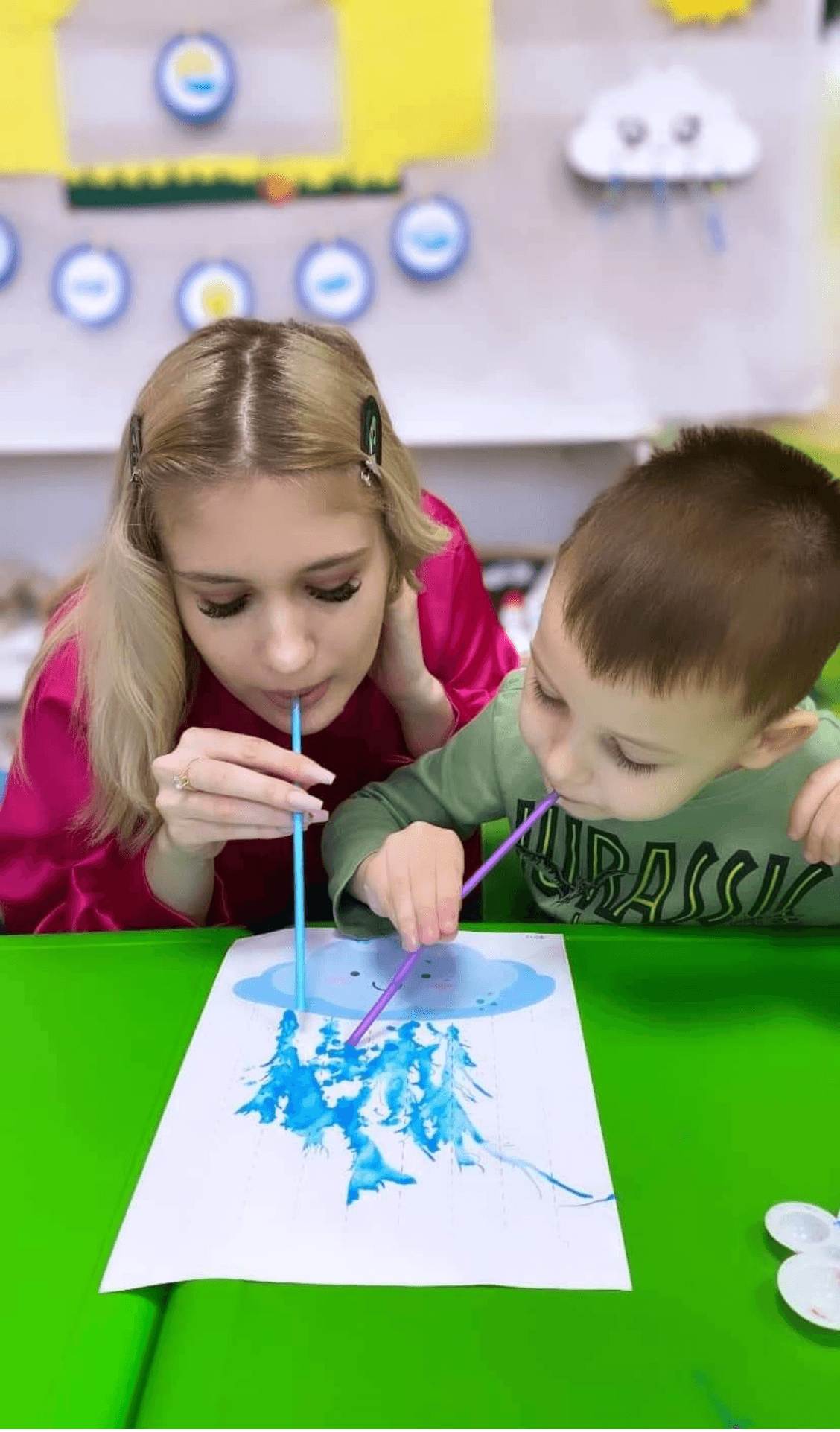
A teacher and a little boy lean over the same page, both blowing through straws. A smiling blue cloud is printed at the top, and puddles of watery blue paint are being blown down the page into branching streaks of rain. The streaks come out different every time, which kids find thrilling.
It’s also a breathing exercise in disguise. Long, steady blows push the paint farther, so kids practice controlling their breath without anyone saying the word “calm.”
Ages: 4 to 5 (many 3 year olds suck instead of blow) · Time: 15 minutes · Mess: Medium · Supervision: Close
You’ll need: white paper with a cloud drawn or printed at the top, blue paint thinned until it’s as runny as milk, straws, and a spoon or dropper.
Free swap: any blue paint watered down will work.
- Drop a small puddle of thin blue paint just under the cloud.
- Hold the straw close to the puddle, aimed down the page.
- Blow in short, strong puffs to push the rain downward.
- Add more puddles and keep going until the cloud is “empty.”
Tip: Snip a small slit near the top of each straw. If a child sucks instead of blows, they get air, not a mouthful of paint.
Trade off: Thick paint won’t budge however hard kids blow, and that’s when they give up, so test it yourself first. Some kids also get lightheaded, so build in breaks every few blows.
12. Weather Clothes
This setup strings a length of twine across a shelf, with a “Winter Clothesline (Fine Motor)” sign behind it. A blue tub below is full of printed paper clothes: mittens, striped scarves, bobble hats, trousers, socks, and sweaters. Kids pick a piece and hang it on the line with bright plastic clothespins in red, yellow, green, and blue.
Squeezing a clothespin is real work for small hands. It builds the same pinch strength kids need later for holding a pencil, and they think they’re just doing laundry.
Ages: 4 to 5 (3s can join with bigger pegs) · Time: 15 minutes · Mess: Low · Supervision: Light
You’ll need: twine or yarn, plastic clothespins, paper clothes (laminated if possible), and a tub. Free swap: real doll or baby clothes with wooden pegs from the laundry basket.
- Tie the line tightly at a child’s chest height between two sturdy points.
- Put the clothes in a tub underneath.
- Show the “alligator mouth” pinch: squeeze, open, bite the edge.
- Ask kids to hang only what they’d wear in the snow, or to build a full outfit.
Tip: Plastic pegs with wide grips are much easier than wooden spring pegs for small fingers. Start there.
Trade off: Paper clothes tear after a few days of handling, so laminate them or glue them to cardstock if the line stays up all week. Take the line down when the activity is over.
13. Cloud Craft
The child in this photo is holding up a sheet titled “My Shape Clouds”: six outlined shapes (a triangle, a square, a hexagon, a heart, a rectangle, and a circle) all filled with white cotton. The cotton has been pulled and stretched so it looks soft and cloudy rather than lumpy. It was made outdoors on a picnic blanket, which is the perfect spot to look up at real clouds afterward.
It mixes two lessons at once. Kids name each shape as they fill it, then go hunting for shapes in the sky.
Ages: 3 to 5 · Time: 20 minutes · Mess: Medium · Supervision: Medium
You’ll need: blue paper, a thick black marker, cotton balls, and white liquid glue such as Elmer’s School Glue, plus a small brush or cotton swab.
Free swap: torn white tissue paper instead of cotton.
- Draw 4 to 6 simple shapes with the marker.
- Show kids how to pull a cotton ball apart so it gets wispy.
- Brush glue inside one shape, then press the cotton on firmly.
- Fill every shape, then head outside to find shapes in real clouds.
Tip: Glue sticks won’t hold cotton. It pops right off once the page dries, so use liquid glue and press hard.
Trade off: Cotton balls are a choking risk for kids under 3, and they’re the item most likely to turn into a snowball fight (see the intro). Hand out a few at a time.
14. Water Play
Four kids in this photo crowd around a red water tray filled with soapy foam and pale pink water. They’re scooping with bowls, cups, and a little jug, and a couple of toy fish are swimming through the bubbles. Paper chains and fish decorations hang on the wall behind them.
Water play turns rain into something kids can pour, catch, and measure. It’s also one of the calmer weather activities for preschoolers who find paint overwhelming. Ask where rain goes after it falls (puddles, rivers, the sea) and let the fish tell the story.
Ages: 3 to 5 · Time: 20 to 40 minutes · Mess: High · Supervision: Constant
You’ll need: a water tray or large plastic bin, warm water, a squirt of tear free baby shampoo for bubbles, cups, scoops, a small watering can, toy sea animals, and towels. Free swap: a baby bath, an under bed storage box, or the bathtub at home.
- Fill the tray only a few inches deep with warm water.
- Add a little tear free shampoo and swish to make foam.
- Add scoops, the watering can, and the toy animals.
- Let kids “make it rain” over the fish and talk about where the water goes.
Tip: The watering can is the star. Pouring from up high is the closest kids get to making real rain.
Trade off: Constant supervision is not optional with any amount of water. The floor around a tray also gets slippery, so lay down a towel or mat and wipe as you go.
15. Weather Sort
Three large header cards (Sunny, Snowy, and Rainy) sit on a table, and a pile of clothing picture cards has been sorted under each. The sunny group has a tee shirt, flip flops, sandals, a cap, a tank top, and sunglasses. The snowy group has a hat with ear flaps, a puffy jacket, thick socks, boots, a bobble hat, and mittens. The rainy group has a rainbow umbrella, green rain boots, a yellow raincoat, and a hooded coat.
Look closely, though: a straw sun hat has landed in the rainy group. That’s the best part of a sort like this. Ask the child why, and you might hear, “Because it keeps the rain off.” They’re not wrong.
Ages: 4 to 5 · Time: 15 minutes · Mess: Low · Supervision: Light
You’ll need: three weather header cards and 15 to 20 clothing cards, ideally laminated. Free swap: cut pictures out of old clothing catalogs or store flyers.
- Lay out the three header cards and talk about each one.
- Shuffle the clothing cards and deal them face down.
- Each child flips a card, names the item, and places it.
- Talk through any “wrong” sorts instead of fixing them.
Tip: Add a few tricky cards (sneakers, a long sleeve shirt, a hoodie) that fit more than one group. The debate is the point.
Trade off: Printable cards need a printer and ideally a laminator. The catalog version works without either but takes longer to prep.
16. Rain Painting
This wall display is a row of umbrella paintings, and each one starts with half a paper plate. Kids painted their plate purple, yellow, teal, pink, or red, and the scalloped plate edge becomes the umbrella’s frilly rim. A curved black handle sits underneath, and the page around it is covered in fingerprint raindrops in two shades of blue. Each square is signed with the artist’s name in the corner.
The fingerprint drops are the charm here: no two the same, some smudged, some perfect ovals. It’s a good first painting project because the plate gives kids a big, forgiving surface to cover.
Ages: 3 to 5 · Time: 20 minutes plus drying · Mess: Medium · Supervision: Light
You’ll need: paper plates cut in half, washable paint, white cardstock, black pipe cleaners or black paper strips for handles, blue paint for fingerprints, and glue. Free swap: a half circle of cereal box card in place of the plate.
- Cut the paper plates in half (adult job) and let kids paint them a bold color.
- While they dry, kids dip a fingertip in blue paint and dot raindrops across the cardstock.
- Glue the dry plate near the top and add a curved black handle underneath.
- Write each child’s name and the date in the corner.
Tip: Offer two blues for the raindrops, one light and one dark. It looks far more like real rain, and it gives kids a choice to make.
Trade off: Two drying stages make this a two session project for most groups. Paint the plates in the morning and put everything together after nap or lunch.
17. Winter Scene
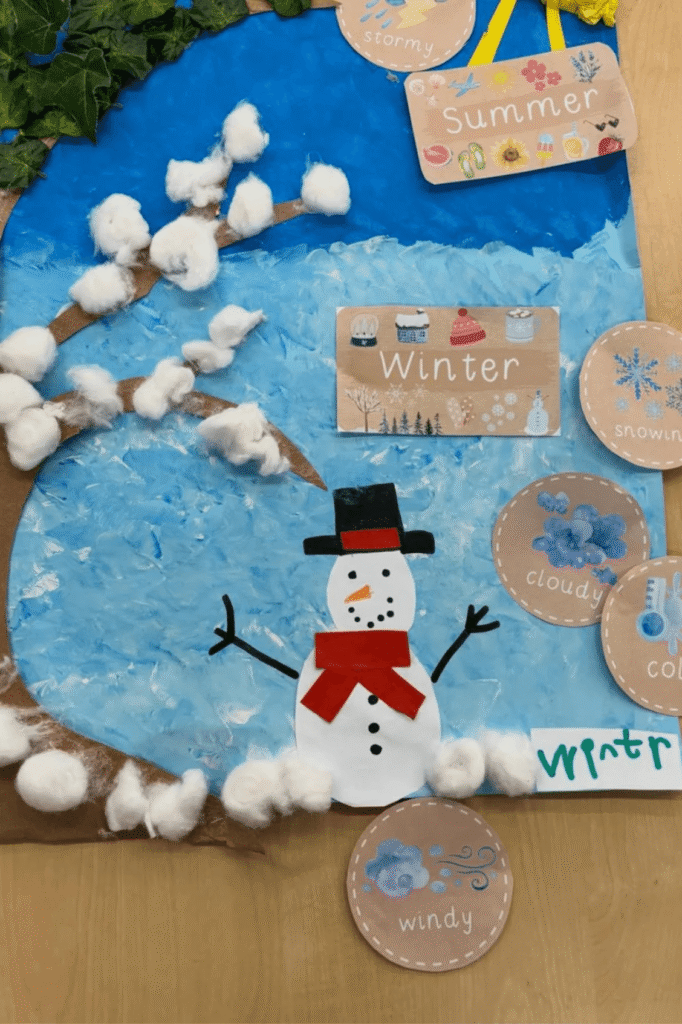
This one is a whole season board. A brown paper tree curves around a lake painted in light blues, and its branches are loaded with cotton ball snow. A paper snowman stands in the middle with a black top hat, a red scarf, an orange nose, and stick arms. Round kraft tags around the edge read stormy, snowing, cloudy, cold, and windy, and a “Summer” card at the top waits for later in the year.
The best detail is the green handwritten label at the bottom that says “wintr.” A child wrote that. Leave invented spelling exactly as it is, because it shows a 4 or 5 year old sounding out a word on their own, which is worth more than a perfect printed label.
Ages: 4 to 5 · Time: 30 to 45 minutes over two days · Mess: Medium · Supervision: Medium
You’ll need: a large sheet of card or a bulletin board, blue paint or blue tissue paper, brown paper, cotton balls, white and black paper, red felt or paper, liquid glue, and word tags. Free swap: a panel from a big cardboard box for the base, and torn white paper for snow.
- Paint or tissue paper the lake and sky on day one, and let it dry.
- Cut and glue a brown tree around the edge.
- Kids glue cotton snow onto the branches and build the snowman together.
- Add the weather word tags and let kids write their own labels.
Tip: Build the snowman on the table and glue the finished figure onto the board last. Kids lose interest quickly standing at a wall.
Trade off: It’s a bigger project that needs two sessions, but it stays up for weeks. Swap the snow for leaves or flowers each season and it becomes an all year seasons board.
18. Rain Station
In this classroom, a clear umbrella with blue trim hangs from the ceiling, with strings beneath it holding shiny blue raindrops and small red and white word cards. You can spot sight words like “we,” “play,” “the,” and “this” on the cards, and rain words like “absorbent” written on some of the drops. On the shelf below, red and yellow watering cans and cups wait for water play, so the whole corner becomes a rain zone.
This is one of the weather activities preschool classrooms can leave up for a whole unit, because it works as a reading corner and a display at the same time. Kids stand under the “rain,” find a word they know, and read it out loud.
Ages: 4 to 5 · Time: 45 minutes to build · Mess: Low · Supervision: Light once it’s hung
You’ll need: an umbrella (clear or any color), fishing line or thin string, blue card for raindrops, word or letter cards, and a ceiling hook. Free swap: an old broken umbrella with the fabric removed, or a hula hoop.
- Cut 10 to 15 raindrops from blue card and write a letter, number, or word on each.
- Tie them to the umbrella spokes at different lengths.
- Hang the umbrella from a ceiling hook (an adult job, with a step stool).
- Set a basket of rain books and the watering cans underneath.
Tip: Match the drops to your group: letters for 3s, numbers to 10 for 4s, and simple sight words for 5s, like the ones in the photo.
Trade off: It’s the slowest to build, and once it’s up high, kids can’t hold the drops. Keep every string short and the whole mobile above head height, then tape a matching set of drops on a low wall for kids who want to touch them.
19. Weather Wheel
This “Today’s Weather Is…” wheel is all about texture. The cloudy section has soft white pom poms and foam clouds. Windy has white pipe cleaners twisted into swirls with little colored leaves flying past. Snowy is covered in foam snowflakes, sunny has a sparkly glitter foam sun, and the rainy and stormy slice has gray pom poms, a yellow pipe cleaner zigzag for lightning, and shiny blue gem raindrops.
Every section feels different under a finger, so kids can “feel” the weather before they name it. It’s brilliant for kids who learn by touch, and for any child still building their weather words.
Ages: 3 to 5 · Time: 45 minutes for an adult to make, 2 minutes a day · Mess: Low · Supervision: Medium (small glued parts)
You’ll need: a round cake board or large paper plate, colored card, pom poms, pipe cleaners, foam and gem stickers, glitter foam sheets, strong glue, a card arrow, and a brass fastener. Free swap: cotton wool, fabric scraps, crumpled foil for lightning, and bubble wrap for rain.
- Divide the circle into five sections and color each background.
- Glue a different texture into each section (do this part yourself, with strong glue).
- Label each section in big letters around the rim.
- Add the arrow in the center and use it each morning: touch, name, point.
Tip: Let kids help choose the textures. Ask, “What does wind feel like?” and see what they pull from the craft bin.
Trade off: The textures make it great, and they also make it a choking risk for toddlers. Use tacky glue or an adult run hot glue gun, and check weekly for anything coming loose.
20. Rain Boots
Two finished pieces in this photo show the same rainy day scene. Gray storm clouds with yellow lightning sit at the top, and blue rain streaks run down the page. Below, an umbrella outline is filled with bright round dot stickers, and a pair of painted rain boots stands beside it, red in one picture and dark green in the other.
It’s a mixed media project, which means kids get three different jobs: dragging paint for rain, matching stickers to circles, and painting boots any color they like. The boot paint is thick and patchy, and that’s exactly how it should look.
Ages: 3 to 5 · Time: 25 minutes · Mess: Medium · Supervision: Light
You’ll need: white cardstock with a printed umbrella (with circle spaces) and boot outline, round dot stickers or Do A Dot Art markers, blue paint with a fork or old brush for rain, and red or green paint for the boots. Free swap: cotton swabs dipped in paint for the dots.
- Print or draw the umbrella and boot outlines, with circles inside the umbrella.
- Kids match dot stickers to the circles, naming each color as they go.
- Paint the boots any color.
- Drag a fork dipped in blue paint down the page to make rain.
Tip: Do the stickers first and the paint last. Sticky stickers and wet fingers do not mix.
Trade off: The template does a lot of the work, so it’s less open ended than the other crafts. Keep blank paper nearby for kids who want to draw their own boots.
Common Mistakes With Preschool Weather Activities
These are the first try slip ups that come up again and again with weather activities for preschoolers.
- Starting with the craft instead of the window. If kids don’t connect the activity to the sky outside, it’s just painting. Look out first, every time.
- Paint that’s too thick for blowing or dripping. Rain Clouds and Drip Paint both need paint as runny as milk. If it doesn’t move when you tilt the cup, add water.
- Gel shaving cream in the cloud jar. Gel never fluffs up properly, so the rain barely falls. Buy plain foam.
- Glue sticks with cotton. The cotton falls off the minute the page dries. Liquid glue only.
- Too many sorting groups for young threes. Start with hot and cold. Add rainy, windy, and snowy once they’re bored.
- Putting every play dough color out at once. You’ll end up with one gray lump. Put out only the colors each mat needs.
- Big spray bottles set to stream. A stream blasts paint off the page and soaks the floor. Use small bottles set to mist.
- Explaining instead of asking. Ask “What do you think will happen?” before the cloud jar rains. A child’s own guess sticks better than your explanation.
- Cramming everything into one weather day. Ten activities on a Friday is exhausting for everyone. One small activity a day over two weeks works far better.
FAQs
How Can You Teach Preschoolers About Weather Without Making It Feel Like School?
Turn each idea into something kids do: spray water to make rain, blow paint to make wind, and spin a weather wheel to pick a movement game. Keep each activity to 10 to 20 minutes, start at the window, and ask questions instead of explaining.
What are good activities about weather for preschool at home?
Easy home picks are the shaving cream cloud jar, paper plate umbrella painting, a hot and cold sort with real clothes, and water play in the bathtub with a watering can. All four use things most homes already have.
What Are The Best Weather Activities For Preschoolers With Short Attention Spans?
Choose activities with fast, visible results, like straw blown rain, drip painting, the cloud jar, and the weather spinner movement game, since something happens within seconds. Give each child one clear job and stop while they’re still enjoying it.
How long should preschool weather activities last?
Plan on 5 to 10 minutes for young 3 year olds, 10 to 20 minutes for 4 year olds, and up to 30 minutes for 5 year olds. Bigger projects like the Winter Scene work better split across two short sessions.
Is shaving cream safe to use with preschoolers?
Plain foam shaving cream is widely used for the rain cloud experiment, but keep it away from eyes and mouths and wash hands afterward. For children with sensitive skin, or little ones who still put things in their mouths, use a sponge cloud instead.
What weather words should preschoolers learn first?
Start with sunny, rainy, cloudy, windy, and snowy, because kids can see or feel each one. Add hot, cold, stormy, and rainbow once those feel familiar.
Before You Set Up Tomorrow
If you only try one thing from this list, make it the Weather Wall or the Weather Spinner. A two minute daily habit does more than any single craft, and every other activity here plugs straight into it.
Read next: If your weather unit lands in October, our Best Halloween Pumpkin Crafts For Easy Fall Decor roundup pairs nicely with the rain and wind projects.
Whatever you pick, the best activities about weather for preschool start the same way. Tomorrow morning, before anyone sits down, open the curtains and ask what the sky is doing. The paint can wait until after snack.
