
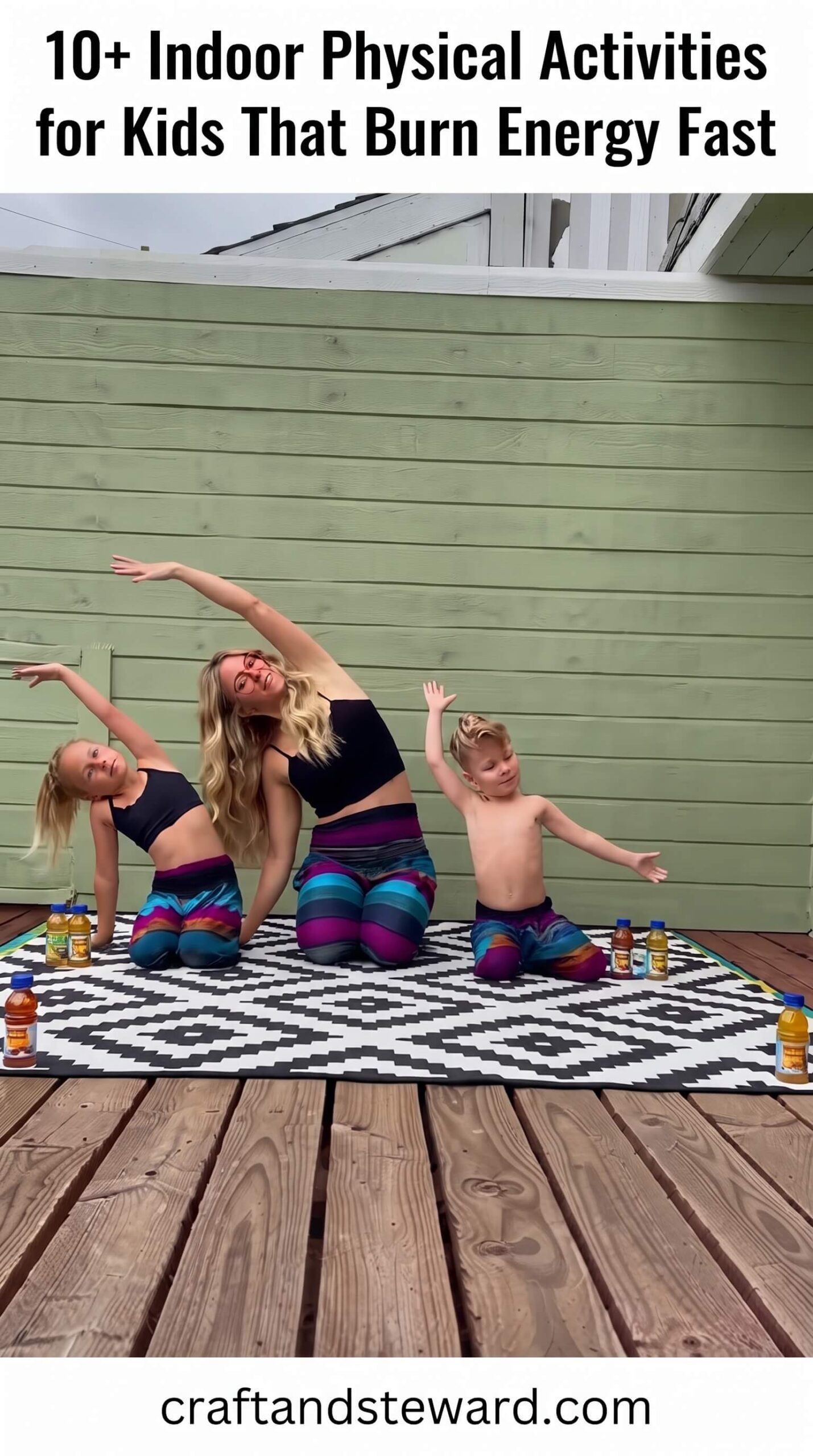
It’s 9:40 on a rainy Saturday. Breakfast is done, the cartoons are off, and my youngest has already launched off the arm of the couch twice. The older one is “just walking” laps around the kitchen, which somehow sounds like a herd of horses.
Rainy days turn my house into a pressure cooker of restless kids. Screens buy me an hour, maybe, and then the bouncing comes back worse. What actually works is real movement: indoor physical activities for kids that get hearts pumping without destroying the furniture or my last nerve.
Every idea below fits in a living room or hallway, uses stuff you probably already own, and has been tested on my own crew more times than I can count. I’ve included the parts most lists skip: how messy it gets, how close you need to stay, and what goes wrong the first time.
With the school year back in full swing and the evenings getting dark earlier, this list is back on our fridge for the season.
Quick answer: The best indoor physical activities for kids who need to burn energy fast are freeze dance, balloon volleyball, an indoor obstacle course, bubble wrap stomping, and red light, green light. All five work in a living room or hallway with household items and get most kids ages 3 to 10 breathing hard within about 10 minutes. When you need calm more than chaos, kids yoga and Simon Says turn movement into focus instead.
Why These 10+ Indoor Physical Activities for Kids Made My List
I picked these after years of trial and error with my own kids. Space was the first filter. Most of us don’t have a spare playroom, let alone a home gym, so every idea had to work in a hallway or a regular living room.
Safety came next. Soft equipment only. No hard balls flying toward lamps, and nothing that needs a kid to climb higher than the couch cushions.
I also wanted variety. Some of these spike the heart rate fast. Others build balance or just shake the wiggles out. A few quietly sneak in listening practice, which my kids have never once noticed.
And I skipped anything that needed gear I’d never actually buy. Whenever an activity calls for something from the store, you’ll find a free swap right next to it.
Why bother at all? The CDC recommends that kids ages 6 to 17 get at least 60 minutes of moderate to vigorous activity every day, and preschoolers should be active throughout the day. On a rainy day, that hour doesn’t happen by accident.
Quick Comparison: Which Indoor Physical Activity Fits Your Kid Today
Scan it, pick one, go. Total time includes setup, play, and cleanup.
| Activity | Best ages | Total time | Mess level | Supervision | Energy burn |
|---|---|---|---|---|---|
| Freeze Dance | 2 to 10 | 10 to 15 min | None | You’re the DJ | High |
| Indoor Obstacle Course | 3 to 12 | 1 to 1.5 hours | Medium to high | Close during build, then check ins | High |
| Balloon Volleyball | 4 to 10 (3 with you right there) | 20 to 35 min | Low | In the room for under 8s | Medium to high |
| Simon Says | 4 to 10 | 10 to 15 min | None | You lead | Medium |
| Hallway Bowling | 2 to 10 | About 25 min | Very low | Check in every few minutes | Low to medium |
| Paper Plate Skating | 3 to 10 | 15 to 20 min | None | In the room | Medium |
| Bubble Wrap Stomp | 3 and up | 15 to 20 min | Low (but loud) | In the room | High, short burst |
| Red Light, Green Light | 3 to 10 | 10 to 15 min | None | Adult calls first round | High |
| Tape Hopscotch | 4 to 9 | About 30 min | None | Check in every few minutes | Medium |
| Follow the Leader | 2 to 12 | 10 to 20 min | None | Light | Medium to high |
| Bookworm Workout | 2 to 7 | About 15 min | None | You’re reading | Medium |
| Kids Yoga | 3 to 12 | 10 to 20 min | None | Light | Low (calming) |
Save this for later: If you’re reading this on a dry day and just planning ahead, pin the image above or screenshot this table. The next rainy Saturday, you’ll want it in about four seconds.
Indoor Physical Activities for Kids
1. Freeze Dance: Music Stops, Bodies Stop
This is the one I reach for when the couch jumping has already started, because setup takes about 30 seconds.
Ages: 2 to 10 | Time: 1 minute setup, 10 to 15 minutes of play, no cleanup | Mess: none | Supervision: you’re the DJ, so you’re right there anyway
All you need is a phone and a playlist. No speaker? Drop your phone into an empty mug or mixing bowl. It pushes the sound out louder than you’d expect, and it costs nothing.
- Clear a patch of floor about the size of a rug. Push toys to the edges, because kids freeze on one foot and topple onto whatever is nearby.
- Pick songs with a steady beat and let them dance however they want.
- Pause the music at random. Anyone still moving is out for one song.
- The last dancer standing becomes the next DJ.
Tip: Don’t pause at the end of a chorus. Kids catch the pattern within three rounds and start freezing early. Stop in the middle of a line and they have to actually listen.
The thing nobody warns you about: decide before the first song whether a wobble counts as moving. If you don’t, you’ll spend more time refereeing than playing.
For kids under 4, skip being “out” entirely. Everybody freezes, everybody unfreezes, everybody giggles. For 8 and up, call out the pose they have to freeze in (“flamingo,” “zombie,” “statue of Mom”) so it stays a challenge.
The downside is noise. Stomping carries through floors, so if you have downstairs neighbors, this is a morning game, not a 7 p.m. game. It can also overwhelm sensory sensitive kids once the volume creeps up. Hand that kid the DJ job and watch how fast they warm to it.
Freeze dance still ranks as my fastest way to drain excess energy in under ten minutes.
2. Indoor Obstacle Course: Build Once, Race Often
I grab couch cushions, a couple of chairs, and a roll of ScotchBlue painter’s tape. Twenty minutes later, the living room is a course. Kids crawl under the table, hop across pillows, step over tape “lasers,” and finish with a victory spin.
Building it is half the fun. My kids argue over the order of stations, then spend the next hour trying to beat their own times. It’s the longest lasting activity on this list. It’s also the messiest.
What you’ll need, and what to use instead
| Item | Free or cheaper swap |
|---|---|
| Couch cushions | Bed pillows, folded comforters, throw pillows |
| Painter’s tape for lines | A jump rope, scarves, or a row of shoes on the floor |
| Crepe paper streamers for “lasers” | Toilet paper strips taped wall to wall (they snap on contact, which is actually safer) |
| Kitchen timer | Your phone’s stopwatch |
| Chairs and a table | Already in your house |
Anything store bought here is sitting at Dollar Tree or in most junk drawers.
Setting it up
- Move anything with a hard corner (coffee table, side table) out of the running path, or pad the corners with a folded towel.
- Lay every landing cushion on a rug or yoga mat, never on bare floor.
- Build four to six stations: crawl under, hop across, step over, weave through, spin.
- Walk it once slowly yourself so they see the route.
- Time a few runs, then hand the design over to the kids.
Practical note: Couch cushions on hardwood are basically skateboards. The first kid who jumps onto one will slide straight into the wall. Rug or mat underneath, every single time.
What goes wrong on the first try? Kids pop up too early after the table crawl and bonk their heads. Tell them to keep crawling until they can see the ceiling. And keep any streamer or string either below knee height or above head height, never at neck level where a running toddler can hit it.
Ages 3 to 12 is the sweet spot. For 2 year olds, keep it to three floor level stations (crawl, step, roll) with no jumping off anything. For 8 and up, add a stuffed animal they have to carry the whole way without dropping, or a “lava floor” rule between stations.
Stay close during the build, since chairs get dragged and cushions get stacked into towers. Once it’s running, big kids need a check in every few minutes. Under 5s need you in the room. Comfortable clothes with knees you don’t care about help too, because there’s a lot of crawling.
The real catch is space and cleanup. In a small apartment, scale it down to three stations; it still works. Budget 15 minutes to put the living room back together, longer if the cushions turn into a fort (they will). If your kids fight over turns, run timed solo laps instead of side by side races.
Once they own the course design, they stay moving far longer than any screen ever managed.
3. Balloon Volleyball: Soft Hits, Big Laughs
Safety first on this one, because it’s the activity parents most often underestimate.
In the US, latex balloons are required to carry a choking warning: kids under 8 can choke or suffocate on uninflated or broken balloons. So for kids under 8, you stay in the room. If a balloon pops, everyone freezes while you pick up every single piece. For 2 year olds, skip the balloon and use a beach ball.
Now the fun part. I blow up one balloon, stretch a piece of yarn between two chairs for a net, and declare open season. The balloon floats slowly enough that even preschoolers can return it. We keep score, or just count how many hits we can get before it touches the floor.
That slow float means nobody breaks a lamp. Kids spike, headbutt, and kick without me hovering over the furniture. I’ve watched 20 minute rallies that left everyone breathless.
Who it fits: 4 to 10 is the sweet spot, and 3 year olds can play with you right beside them. Easier version: no net, everyone just keeps it in the air together. Harder version for 8 and up: no hitting twice in a row, or two balloons at once.
How long: 2 minutes to set up, 15 to 30 minutes of play, 1 minute to clean up (plus a floor check if one popped).
Mess: none, unless it pops.
Supplies: a pack of latex balloons (Dollar Tree carries them) and some yarn. Free swaps: leftover birthday balloons, or a beach ball from the summer bin. Instead of a yarn net, a strip of painter’s tape on the floor works as a center line, or line up a few dining chairs.
- Turn off the ceiling fan. I learned this one the hard way; the fan grabs the balloon and either fires it across the room or pops it.
- Blow the balloon up to about three quarters full. A fully stretched balloon pops at the lightest bump.
- Tie the yarn net above the tallest kid’s head, or use the floor line. A string at neck height is a clothesline for a running kid.
- Serve, and keep it off the floor.
After about ten minutes, static builds up and the balloon starts sticking to hair, the couch, and everyone’s sweaters. My kids think this is the best part.
It won’t work for kids who are scared of popping sounds. For them, the beach ball swap takes the fear out completely.
Balloons eventually pop, so keep a spare pack nearby. That’s the only running cost. Balloon volleyball delivers pure play with almost zero setup drama.
4. Simon Says: Listen Hard, Move Harder
Here’s the thing about Simon Says: it only burns energy if the commands do. “Touch your nose” won’t tire anyone out. “Simon says run in place until I say stop” absolutely will.
I stand in front and fire off commands fast. The second I drop the “Simon says,” anyone who moves is out for that round. I switch leaders every few minutes so everyone gets a turn bossing the group.
My favorite high energy commands:
- Simon says do 10 jumping jacks
- Simon says bear crawl to the door and back
- Simon says do 5 frog jumps
- Simon says crab walk to the couch
- Simon says run in place, fast, faster, fastest
- Simon says hop on one foot and count to 10
A developmental note that saved me a lot of frustration: most 3 year olds don’t get the trick yet. They copy every command, “Simon says” or not, and then cry when they’re out. For that age, play “Simon does” with no outs at all. For 9 and up, stack commands (“Simon says hop on one foot and touch your head”) and speed up.
There’s no setup, no supplies, and no cleanup, and a good session runs 10 to 15 minutes. Zero mess. You’re leading, so supervision takes care of itself. When a kid takes over as Simon, stay nearby as the referee.
It gets competitive fast. The first kid out is usually the one who needed the movement most, so turn outs into “Simon’s helpers” who watch for sneaky movers. Keep rounds short and celebrate the last person standing without making the early outs feel bad.
Simon Says still teaches more listening skills than any lecture I have ever tried.
5. Hallway Bowling: Soft Pins, Soft Balls
I line up empty plastic bottles at one end of the hallway. A rolled up pair of socks or a light foam ball becomes the bowling ball. Kids take turns rolling from a taped start line, and we keep a running score on a scrap of paper.
The one adjustment that changes everything is water. Empty 16 oz bottles tip over if the ball just gets close, which is perfect for a 3 year old and boring by age 7. For older kids, pour about an inch of water into each bottle and screw the caps on tight. Now they have to actually aim.
Five minute setup
- Pull 6 to 10 bottles out of the recycling and rinse them.
- Set them up in a triangle at the far end of the hallway.
- Tape a start line. Toddlers can roll from halfway down.
- Two rolls per turn, then everyone helps reset.
Budget swaps: The bottles are free. No bottles? Stack paper towel tubes or build a pyramid of paper cups. A foam ball from the dollar store bounces nicely, but rolled socks are free and don’t ricochet into bedrooms. A shoe works as a start line if you’re out of tape.
Safety for little ones: Bottle caps are a choking hazard for babies and toddlers. For kids under 3, tape the caps on, or use bottles with no caps and no water, and count every cap back in when you’re done.
At a glance: ages 2 to 10 | 5 minutes setup, 15 to 20 minutes play, 2 minutes cleanup | mess: almost none (a little water if a cap wasn’t tight) | supervision: check in every few minutes for kids 5 and up, stay close for toddlers
Younger kids push the ball with both hands, and that’s fine. Older ones try spin shots and argue about whether the bottle that wobbled counts. If you have a kid who melts down over low scores, skip the scoring and just cheer every knockdown.
The only limit is hallway length, and even a short one works. The one annoyance: the hallway is also where everybody walks, so expect a few rounds of “MOVE!”
Hallway bowling turns a boring corridor into the best lane in the house.
6. Paper Plate Skating: Glide and Spin
First, check your floor. Hardwood, tile, laminate, or sealed vinyl will work. Carpet won’t; it kills the glide completely. Sweep before you start, because a grain of grit trapped under a plate can scratch a wood floor.
I hand each kid two paper plates. They stand on them and slide across the floor like figure skaters. We race, spin, and play follow the leader on “ice.”
The first five minutes always go the same way. Kids lift their feet like they’re walking, and the plate stays behind on the floor. Bare feet also grip the plate better than socks, which slip right off.
Tip: Teach “push, don’t lift” before anyone steps on a plate. Keep the foot flat on the plate and slide it forward, like shuffling in slippers.
Who it works for: 3 to 10. Under 3, balance is too wobbly; hold both their hands and “skate” them around, or skip it for now. For 7 and up, add a figure skating routine to music, or a curling game where they push a stuffed animal toward a tape target.
Time and mess: No setup, 15 to 20 minutes of play, 1 minute to toss torn plates in the recycling. No mess at all.
Supervision: Stay in the room. This activity has the most falls on the list. No running starts, and no skating near stairs or the corner of the coffee table.
Supplies: Cheap uncoated paper plates, the thin dollar store kind. They tear faster but glide just as well. Free swap: two kitchen towels or old washcloths. They glide on hardwood and never tear.
Plates tear eventually, so keep a stack ready. This activity still surprises me with how long the novelty lasts.
7. Bubble Wrap Stomp: Pop Until You Drop
I roll out a sheet of bubble wrap on the floor and let the stomping begin. Kids jump, march, and dance until every bubble is gone. The louder the pops, the bigger the grins.
The sensory feedback hooks almost every kid, and the stomping raises heart rates fast. It’s a short burst, though. A big sheet lasts five to ten minutes, tops.
A few things I learned the hard way:
- Bubble size matters. The large half inch bubbles pop loud and satisfying. Small bubbles barely pop under a 4 year old’s weight, and the kid loses interest fast.
- It slides. Bubble wrap on hardwood acts like a loose rug. Tape all four edges down with painter’s tape, and lay it over a rug if you can.
- Socks make it worse. Bare feet or sneakers only.
- It’s plastic film. Plastic is a suffocation hazard for babies and toddlers. Put it away the moment you’re done and pick up any torn scraps, because little ones love to chew popped bubbles.
This one works from about age 3 up. For 2 year olds, only with you right beside them and the wrap fully taped down. For 7 and up, make it a race: pop every bubble in one taped square before the timer runs out.
Plan on 3 minutes to tape it down, 5 to 10 minutes of stomping, and 5 minutes of cleanup. Mess is low but the noise is not. Under 5s need you in the room.
If you’re buying, Duck brand bubble wrap rolls are easy to find at Walmart or hardware stores. The free option is better, though: save it from delivery boxes. Those air pillow packing bags pop too (very loudly). Check your local recycling rules before tossing it, since many curbside bins don’t take plastic film.
It won’t work for noise sensitive kids, or for any house with a baby napping down the hall. Neighbors will hear it too, so I save the big sheets for big energy days.
Bubble wrap stomping still ranks as the most satisfying short burst of movement I have found.
8. Red Light, Green Light: Stop on a Dime
One person stands at the far end and calls “green light.” Everyone moves forward. “Red light” freezes them in place. Anyone caught moving goes back to the start.
The start and stop rhythm builds speed and control at the same time. Kids learn to brake their own bodies on command, which is harder for them than it looks.
Practical setup: Put the finish line three or four feet before the wall. On the last green light, kids sprint, and a wall at the end of a sprint is how you get a bumped forehead. Ask me how I know.
Keep it fresh with extra colors:
- Yellow light: slow motion
- Purple light: walk backward
- Blue light: hop only
- Rainbow light: dance your way forward
It fits ages 3 to 10. For 3 year olds, drop the “back to start” rule and just practice freezing. For older kids, the caller can spin around fast to catch movers, and anyone caught does 5 jumping jacks before heading back.
No setup, no supplies (two shoes or a strip of tape mark the lines), 10 to 15 minutes of play, and nothing to clean up. You call the first round yourself, then check in every few minutes once the kids take over.
The first game always ends in an argument over who moved. Set the rule up front: the caller’s call is final, and the caller changes every round. When you go first, you get to model what fair calls look like.
It works in any size space. Even a short hallway gives you enough distance for drama. Red Light, Green Light never gets old because the tension of almost getting caught stays high.
9. Tape Hopscotch: Classic Lines, Fresh Energy
I use painter’s tape to mark a hopscotch grid on the floor. Kids hop the squares on one foot or two, just like the sidewalk version, minus the chalk dust on everyone’s knees.
What you need: Painter’s tape (ScotchBlue is what I keep in the closet) and something to toss. For the toss marker, use a beanbag or a folded sock. Skip bottle caps and coins if there’s a toddler in the house.
Free swaps: Masking tape works, but it can leave residue on some floors, so test a corner first. On carpet, tape doesn’t stick well. Lay down sheets of printer paper and tape only the corners.
Making the grid:
- Tape squares about 12 to 16 inches wide, roughly one big hop for a 6 year old.
- Lay out three single squares, then a pair side by side, a single, another pair, a single, and a half circle “home” at the top.
- Number the squares with a marker on small scraps of tape.
- Before you commit, press a small piece of tape in a corner and peel it. On waxed or older floors, tape can lift the finish.
It works best from about 4 to 9. Under 4, drop the one foot rule and let them jump with both feet from square to square. For 8 and up, try hopping backward, balancing a beanbag on the head, or numbering the squares by twos or fives so they skip count as they hop.
Time: 10 minutes to tape, 15 to 20 minutes of play, 3 minutes to peel. Mess: none. Supervision: check in every few minutes, and stay close for the backward hopping.
Hopping in socks on hardwood is where the slips happen, so bare feet are better here. And if you live above someone, this is the loudest activity on the list for them.
Tape peels up cleanly if you pull it slowly, and the grid can stay down for days if your floor allows. Tape hopscotch brings outdoor nostalgia inside without any weather excuses.
10. Follow the Leader with Silly Moves
I start as leader and string together moves: high knees, spin, army crawl, jump, freeze. Everyone copies exactly. After a minute, I pass the lead to the next kid.
This is also where animal walks live in our house, and they’re the sneakiest energy burners I know. Try these:
| Animal | The move |
|---|---|
| Bear | Walk on hands and feet, bottom up high |
| Crab | Sit, hands behind you, lift your hips, and walk |
| Frog | Squat low, then jump forward |
| Flamingo | Stand on one leg as long as you can |
| Kangaroo | Feet together, big bounces |
| Inchworm | Walk your hands out to a plank, then walk your feet up to meet them |
Thirty seconds of crab walking leaves most adults breathing hard too. Try it before you judge.
Ages 2 to 12 all work. Toddlers just follow you, and that is the whole game for them. For tweens who’ve decided they’re too cool, flip it and ask them to teach you a “workout class.” Suddenly they’re very into it.
No setup, no supplies, no cleanup, and 10 to 20 minutes of play. Mess level is zero. Supervision is light, with one exception: if the parade travels through the house, you lead the first lap to set the boundaries. No stairs, no rooms with a sleeping baby, no climbing on beds.
The first time, your youngest leader will do the same move for three straight minutes or march everyone into the bathroom. Give each leader a one minute turn on a timer. Shy kids sometimes freeze up when it’s their turn, so let them pick a move from the animal list instead of inventing one.
The constant change keeps attention locked. Kids invent wilder moves once they hold the lead. I’ve seen parades through the whole house last twenty minutes without a single complaint.
Follow the Leader still works because every child eventually gets to invent the rules.
11. Book-Worm Workout: Story Time That Moves
I pick a familiar picture book and assign a movement to a repeated word. Every time “hat” shows up, we do five jumping jacks. “Cat” means a frog jump. We read and move at the same time, and the kids are laughing by page three.
Picking the word matters more than you’d think. If it shows up in every line, the story falls apart. If it shows up twice in the whole book, nobody moves. Once or twice a page is the sweet spot.
Books that work well in our house:
| Book | Word to listen for | Move |
|---|---|---|
| Brown Bear, Brown Bear, What Do You See? by Bill Martin Jr. and Eric Carle | “see” | Jumping jack |
| Chicka Chicka Boom Boom by Bill Martin Jr. and John Archambault | “boom” | Drop into a squat, pop back up |
| Pete the Cat: I Love My White Shoes by Eric Litwin and James Dean | “shoes” | March in place |
| The Cat in the Hat by Dr. Seuss | “hat” and “cat” | Jumping jacks and frog jumps |
Ages 2 to 7 are prime time for this one. For 8 and up, let them choose the word and the move, or have them read aloud to a younger sibling while everyone else moves.
Picking a book and moves takes about 2 minutes, and the reading runs 10 to 15. There’s no mess, and cleanup is putting the book back on the shelf. You’re reading, so supervision is built in. If your shelves are thin, the library is the free swap.
Short books keep the energy up. Long chapter books lose the rhythm fast. My kids now request specific books just for the workout version, which I’m counting as a reading win.
The only kid this doesn’t land with is the one who wants to hear the story without interruptions. Read it through once normally, then do the workout version second.
Bookworm workouts remain my favorite way to combine reading time with real movement.
12. Kids Yoga: Stretch, Breathe, Reset
Yoga as the opener on a wild morning fails every time in my house. They goof around and topple onto each other. Yoga after 15 minutes of freeze dance works almost every time.
So I use yoga as the landing, not the launch. I pull up a free Cosmic Kids Yoga video on YouTube (they’re story based, and my kids ask for it by name) or lead simple animal poses myself. Downward dog becomes a barking dog. Tree pose turns into a wobbly forest. We hold each pose for a few breaths and move on.
Five easy poses to start with:
- Barking dog (downward dog): hands and feet on the floor, hips high, one big bark.
- Wobbly tree (tree pose): one foot resting on the opposite ankle or calf, never pressing into the knee.
- Hissing snake (cobra): lie on the belly, push the chest up, hiss.
- Butterfly: sit with the soles of the feet together and flap the knees.
- Turtle in a shell (child’s pose): knees tucked, forehead down, three slow breaths.
Skip anything upside down, like headstands or shoulder stands. Those put pressure on the neck and need real instruction, not a living room try.
Ages 3 to 12 can all join in. Under 3, they’ll copy for about three minutes and then climb on you, which still counts. For 8 and up, hold poses longer, try tree pose with eyes closed, or do partner poses.
Setup takes a minute, a session runs 10 to 20 minutes, and there’s nothing to clean. Supervision is light; check in and correct the knee on tree pose. A yoga mat helps, but a rug is the free swap. A towel on hardwood slides out from under hands in downward dog.
Yoga sneaks in strength and calm at the same time. I notice better focus afterward, especially before homework. It isn’t cardio, though, so it won’t settle a truly bouncing kid on its own. Pair it with something higher energy first.
Kids yoga remains the quiet hero when the house needs a reset more than a full meltdown release.
How to Choose the Right Activity for Your Day
I match the activity to the energy in the room, and to my own energy, if I’m being honest.
- Kids bouncing off the walls: freeze dance, bubble wrap stomp, or red light, green light. Fast payoff.
- You need them busy for 45 minutes: the obstacle course. Most setup, longest play.
- Tiny space: hallway bowling, paper plate skating, or freeze dance.
- After school, before homework: Simon Says or kids yoga. Movement that ends in focus.
- Zero setup energy left: balloon volleyball or animal walks. Almost nothing to prep.
- Mixed ages: follow the leader. Toddlers copy, big kids lead.
The most common mistake I see is trying to force one activity for too long. Kids burn out on repetition fast. I rotate three or four options in an afternoon and let them vote on the next one. That ownership keeps the momentum going.
Personally, I reach for the obstacle course most often. It uses the most creativity and lasts the longest.
Watch for signs of overload: whining, rougher play, one kid suddenly lying on the floor refusing to move. Switch to something calmer before the mood crashes. The goal is movement that feels good, not another power struggle.
Common Mistakes Parents Make with Indoor Physical Activities for Kids
These are the ones I made so you don’t have to.
Starting with the calm activity. Yoga or a book workout as the first thing on a wild morning turns into chaos. Burn off the big energy first, then wind down.
Letting everyone play in socks. Socks on hardwood plus hopping, skating, or bubble wrap equals slips. Bare feet or grippy socks for anything with jumping.
Running elimination games with toddlers. Freeze dance, Simon Says, and red light, green light all work for little kids, but only when nobody is “out.” A crying 3 year old on the sidelines isn’t burning any energy.
Doing the wildest activity right before bed. My kids come out of an obstacle course more wound up, not less. I keep the high energy stuff at least an hour before bedtime and save yoga for the last stretch of the evening.
Buying supplies before testing the free version. Socks for bowling balls, towels for skates, delivery box bubble wrap. If the free version flops, a bought version probably will too.
Forgetting the littlest sibling during cleanup.
Practical note: The hazards on this list mostly show up after the game ends. A balloon scrap under the couch, a bottle cap in the hallway, a torn strip of bubble wrap. If there’s a baby or toddler in the house, do a quick floor sweep before you call it done.
Frequently Asked Questions
What is the best indoor physical activity for kids who hate structured exercise?
Animal walks and balloon volleyball win for my crew. They feel like pure play, so the movement happens without anyone noticing they’re working.
How do I pick among these 12 indoor physical activities for kids when space is really tight?
Start with hallway bowling, paper plate skating, or freeze dance. All three need almost no square footage and still raise the heart rate.
Are these activities safe for toddlers?
Most work with simple changes: no eliminations, floor level obstacles, and an adult within arm’s reach. Balloons, bubble wrap, and bottle caps are real choking or suffocation risks for little ones, so those need you right there and a full cleanup afterward.
How long should a session last before kids lose interest?
I aim for ten to fifteen minutes per activity, then switch. Longer sessions only work when the kids are fully invested in building or competing, like with the obstacle course.
Can I combine a few of these into one longer play session?
Yes. An obstacle course that ends in a freeze dance party, or follow the leader with animal walks followed by a few yoga poses, keeps the energy high without feeling repetitive.
How do I get painter’s tape off the floor without leaving residue?
Peel it slowly at a low angle, folding the tape back over itself. If it sticks, warm it with a hair dryer for a few seconds, then wipe any leftover adhesive with warm, soapy water. Pull tape within a few days rather than leaving it down for weeks.
These activities have pulled my family through more gray weekends than I can count. The real win is watching the kids invent their own versions once the basic idea sticks.
So pick whichever one feels easiest today, clear a patch of floor, and press play. The rest will follow once the first sweat breaks.